
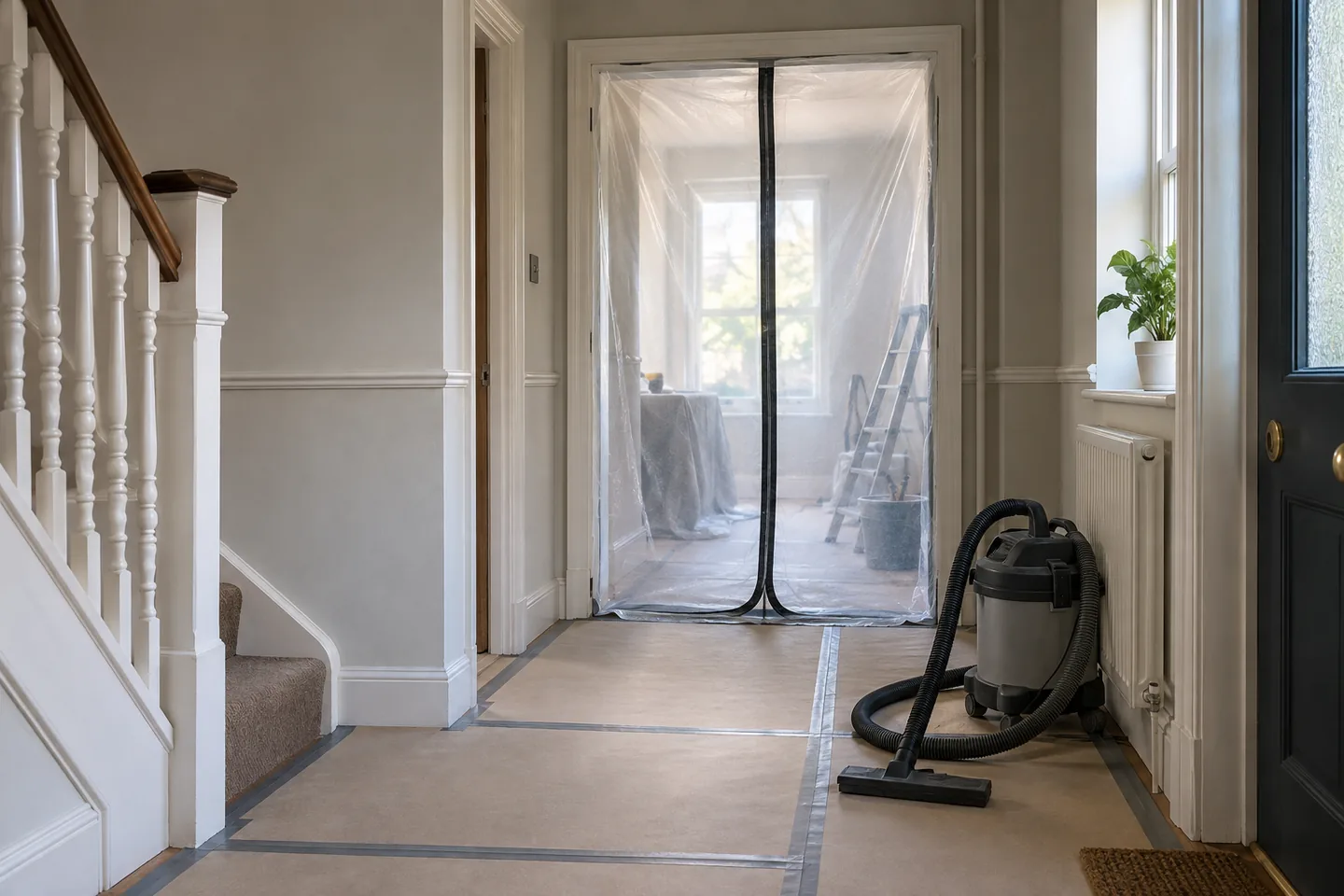
Why dust control is worth planning
Construction dust travels through a house and settles on every surface, including inside cupboards and behind appliances. Silica and plaster dust are respiratory irritants, and fine dust can damage electronics, kitchen appliances and heating systems. A controlled site is also a safer site for the people living there.
Dust control is one of the clearest signals of a well-run project. It is also one of the cheapest things to get right if it is planned at the start, and one of the most annoying to retrofit once the work is under way.
Contain the work zone
Use zip doors and sealed sheeting at doorways rather than leaving openings uncovered. Seal gaps above, below and around the barrier, because dust follows air movement. Close and cover vents, extract grilles and air bricks in the work zone where it is safe to do so.
- Keep the barrier closed; a barrier that stays open is decoration, not containment.
- Tape the edges of the sheeting to the frame so it does not billow open.
- Plan the route in and out of the work zone, including where materials enter.
- Label the barrier so everyone knows which side is which.
Move the air, do not just block it
A negative air machine or an extract fan with a filter keeps air moving into the work zone rather than out of it. HEPA filtration captures fine particles, so check the filter class and change it as it loads up. Do not run central heating or air conditioning that pulls dust into ducts.
Ventilation still has to be maintained for the trades and for any combustion appliances. Sealing a room completely can create other problems, including heat and fume build-up, so air management and safety go together.
Protect floors, stairs and surfaces
Use breathable floor protection where moisture could be trapped and hard protection on finished floors. Protect stairs and handrails, because they are used constantly and damaged easily. Cover fixed items you cannot move, and keep a clear route to the exits at all times.
Protect kitchen worktops, appliances and any furniture that stays. Moving a sofa into another room is often easier than cleaning it twice a week for a month.

Daily routines that make the difference
Vacuum with HEPA equipment at the end of each day rather than sweeping, which simply moves the dust. Wipe down surfaces in the adjacent rooms and change the air where possible. Remove waste regularly instead of letting bags accumulate inside the house.
Agree the routine and the equipment with the contractor before work starts, and put it in the scope. When dust control is written down, it is priced, planned and done rather than negotiated every morning.
Living safely on the other side of the barrier
Keep children and pets out of the work zone and away from tools, dust and wet materials. Watch trip hazards from cables and hoses crossing circulation routes. Keep a working smoke alarm and clear escape routes, even if the layout of the house has changed.
Talk about noise and dust schedules so the household can plan around them. A weekly conversation about the noisiest days is a small courtesy that prevents a lot of friction.
After the work: a proper clean-down
Expect dust to settle for weeks after the work finishes. Do the deep clean after the fine dust has stopped being produced, and change the filters in vacuums, extract fans and heating systems where relevant. Check inside cupboards, on top of units and behind appliances.
Keep the containment up until the dustiest work is finished, then remove it carefully so the trapped dust leaves the house rather than moving into it. A methodical clean-down is the difference between a finished room and a room you can use.

Frequently asked questions
Does plastic sheeting actually stop renovation dust?
It reduces movement when it is sealed and combined with air control, but a single sheet is not effective on its own. Zip doors, sealed edges and filtered extraction make the difference.
Should I turn off my heating during a renovation?
Avoid running systems that can draw dust into ducts or circulate it around the house during dirty work, but keep the property safe and frost-protected. Ask your contractor how they protect the heating system while work continues.
Who cleans up after a renovation?
Agree this in the written scope. Builders usually remove their own waste and leave the site tidy, while a deeper builders' clean is often a separate item. Put the standard you expect in writing.
Dust control is one of the clearest signals of a well-run project. Plan it with the same seriousness as the plumbing, and the house stays liveable while the work happens.
This article is general guidance, not health and safety advice. For significant work, check what your contractor will provide and follow any product and safety instructions.